

Product Strategy: Why Getting It Right Is So Challenging
A Tough Truth About Product Strategy Nobody Talks About.

Most of us agree, that a clear product strategy, backed up by data and research is the backbone of any successful product organization. It aligns the company’s efforts, helping everyone move toward a unified goal. Yet, many teams struggle to get this foundational piece right. Let’s explore why clarity and alignment are crucial and how linking your product strategy to business objectives can make all the difference.
The Importance of Clarity
A clear product strategy ensures that everyone on your team understands both what they’re working on and why it matters. When strategy lacks clarity, confusion seeps into execution—leading to misaligned goals, wasted resources, and frustrated teams.
Unfortunately there is a big gap between what we think great strategy and execution should look like and what we experience in reality. In most cases it might rather feel like this:
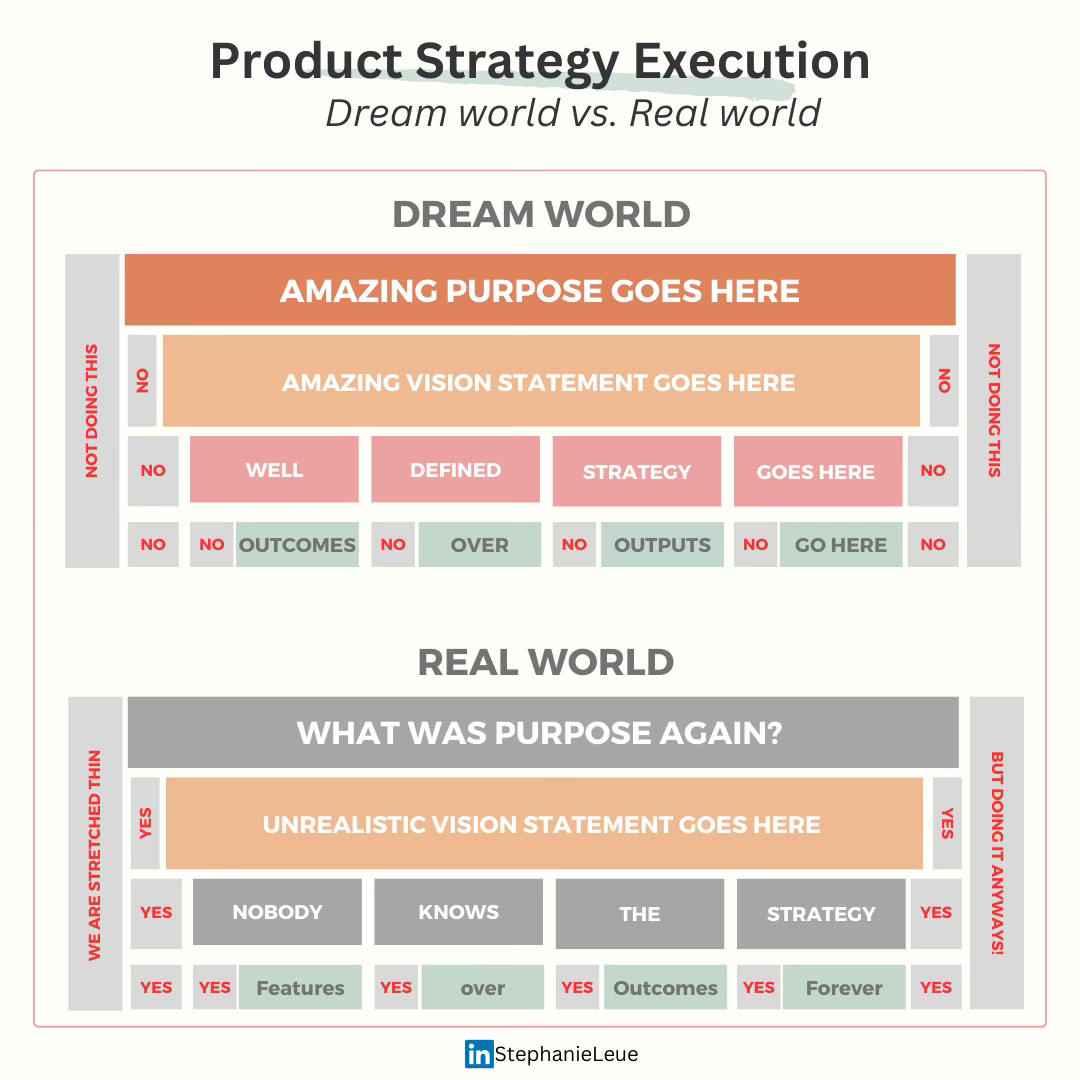
Clarity isn’t just a “nice-to-have.” Research consistently shows that clear strategies drive alignment and execution. When team members grasp how their work contributes to broader goals, they’re empowered to execute effectively. And this isn’t just theoretical—teams with a clear understanding of their strategy perform significantly better than those in the dark.
Clarity is not equal to commitment.
Important: Clarity is not equal to commitment. Not everyone will like or agree or understand your product strategy and that's fine. I have a simple rule of thumb to check if my strategy is “good enough”:
at least 50% of the team agree and commit.
its ok if 20% of the team disagree but commit.
no more than 20% of the team disagree.
no more than 10% just don’t care.
Clarity is a matter of perspective
The C-suite thinks the strategy is clear—but for the teams on the ground, it’s often a shot in the dark. And it’s really no wonder. Execs are deep in the details, constantly brainstorming, meeting with externals, competitors, other C-Levels, advisors, diving into data, and debating the future. Strategy is (hopefully) their daily focus, evolving over time and eventually resulting in… an artifact.
But for everyone else? They typically get the highlights in an all-hands or maybe a workshop or two. Helpful, yes, but it’s just a snapshot. So, it's no surprise there’s often a disconnect.
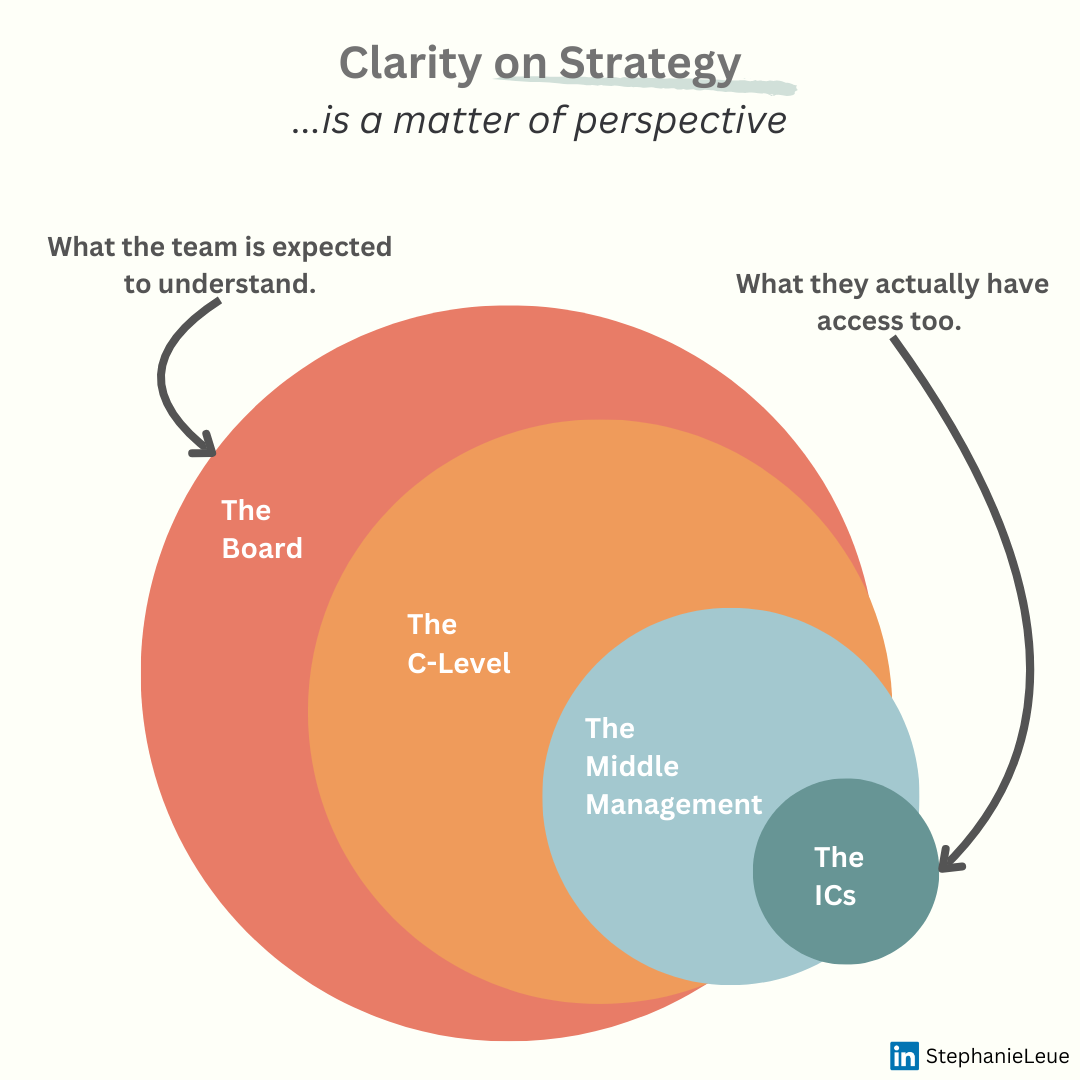
How to bridge it? Make strategy a habit, not a process. Keep it transparent, accessible, and let people join the journey—not just arrive at the final destination.
Action Points:
Take a moment to ask your team: Can you explain our product strategy in one sentence? If the answer isn’t a confident “yes,” it’s time to refine.
Ask each team member and your key stakeholder where their commitment is on a scale from one (disagree) to 10 (agree and commit). If it is below your expectations, it’s time to refine.
Aligning Product Strategy with Business Objectives
Your product strategy doesn’t exist in a vacuum—it’s part of the broader company portfolio. When product goals align with overarching business objectives, magic happens. Why? Because alignment fosters collaboration and shared accountability across the organization.
Misaligned strategies create silos, where product teams focus on goals that don’t move the needle for the company. Execution falters when product initiatives drift from the company’s core objectives. On the flip side, alignment creates momentum. It allows product managers to focus on high-impact work that directly supports the company's success.
Action Points:
Map Product Goals to Business Objectives
Regularly review each product goal and explicitly connect it to a specific company objective.
Use tools like OKRs or a goal-mapping framework to make these connections visible to all stakeholders.
Establish Regular Syncs Between Product and Business Leaders
Schedule recurring meetings (e.g., bi-weekly or monthly) to discuss evolving priorities and ensure alignment.
Use these sessions to validate that current product initiatives still align with broader company goals and pivot as needed.
Summary
To truly integrate your strategy, focus on fostering a shared sense of ownership across teams. Regularly review your initiatives to ensure they support evolving business needs. If your product strategy feels isolated, it’s time to recalibrate.
Product strategy is more than just a document or slide deck; it’s a tool to connect the dots between your team’s work and your company’s success. Clarity and alignment are the pillars that turn strategic intent into measurable impact.
Start there, and you’re already ahead of the game.
Follow me on LinkedIn for daily takes on the real-life world of Product Management.
Asking ”each team member where their commitment is on a scale” assumes a high level of psychological safety to get a useful response. Risking being yelled at (or worse) will make people say whatever they think you want to hear.