

Why Your Product Managers Are Drowning
(And What You As Their Leader Can Do About It)

Most Product Managers I’ve worked with weren’t lazy. They were drowning.
And I’m seeing this over and over again: 70% of their week is reactive work or busywork. Less than 5% is strategically relevant.
No wonder your roadmap feels disconnected. No wonder they’re burned out. No wonder they’re telling you they can’t deliver real value.
The problem isn’t them. It’s the system you and your org have built around them.
The Math Doesn’t Lie
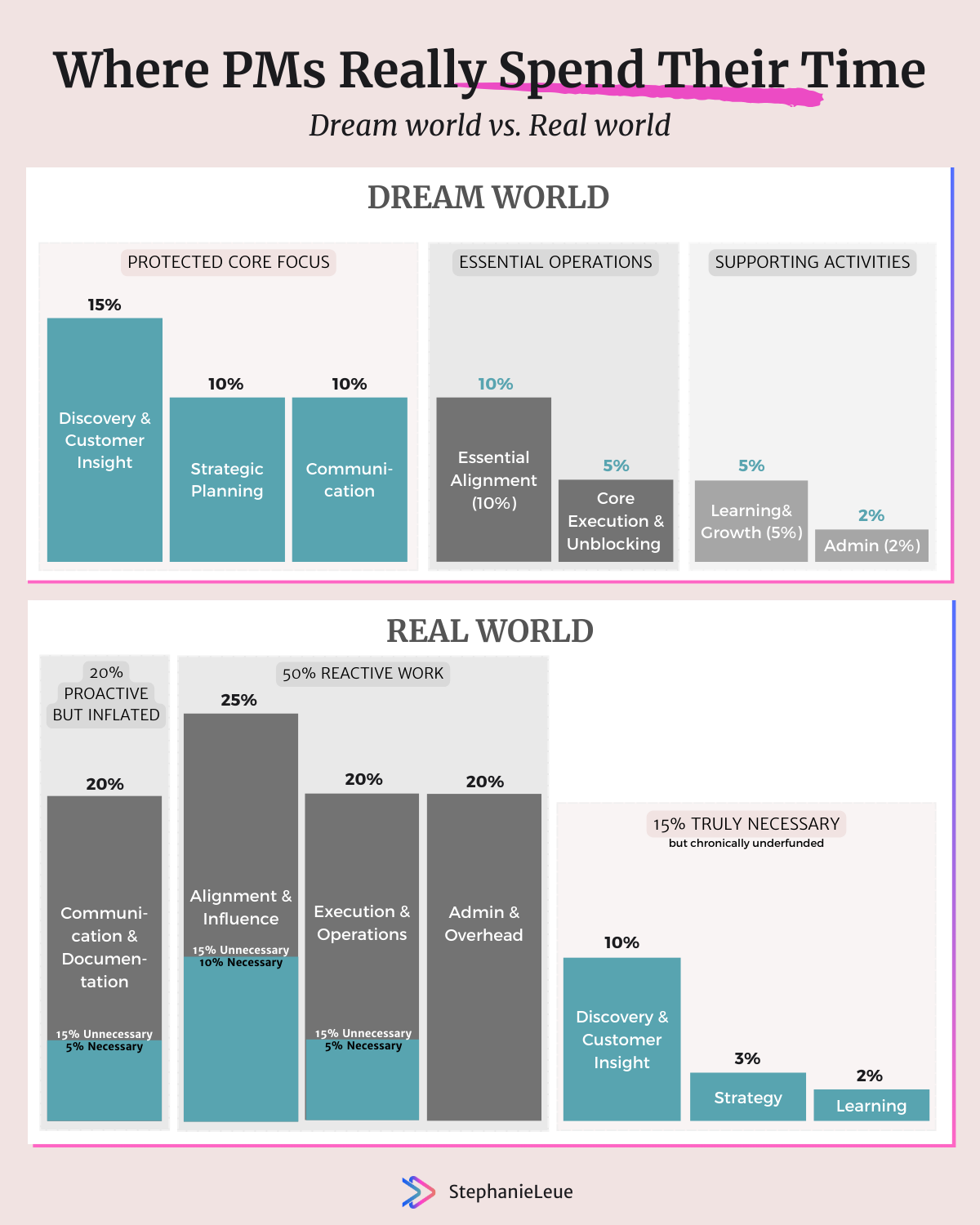
Let me show you where PM time actually goes. Not where it should go. Where it actuallygoes.
When you start tracking your team’s weeks—really tracking it—the reality will most likely look brutal:
Time Allocation in Reality:
25% Stakeholder alignment and reactive negotiations (unplanned meetings, urgent stakeholder requests, scope changes)
20% Administrative overhead and interruptions (email, scheduling, ad-hoc Slack requests, calendar management)
20% Bloated communication and documentation (status reports, presentation decks, redundant documentation, over-communication)
20% Operational firefighting and scope changes (mid-sprint adjustments, blocker resolution, urgent escalations, quick fixes)
10% Discovery and customer insight (customer interviews, feedback analysis, research, competitive analysis)
3% Strategic thinking (vision refinement, roadmap prioritization, trade-off decisions, frameworks)
2% Learning and growth (industry trends, continuous improvement, professional development)
That’s 70% reactive or busywork. 13% that actually moves the product forward.
Here’s what hits hardest: most PMs recognize this number immediately. They don’t need me to explain it. They live it every single day.
The difference you can make is to finally started asking: Why are we accepting this as normal?
Here’s Why It Matters
When discovery and strategy are starved for time, everything downstream breaks.
Your roadmap becomes a stakeholder wishlist. Every request gets added because you lack the clarity—or the courage—to say no. The result is a roadmap that makes nobody happy and solves nothing strategically. You end up with what I call “the reality gap”—a gap between what you planned and what actually happens, between dream and reality.
Your teams ship features that don’t move metrics. Velocity looks great. Release notes are long. But adoption is flat. Retention doesn’t budge. You’re shipping features into a void because nobody took time to understand the customer problem deeply enough. You’re building a feature factory, not a product company.
Your competitive advantage erodes because you’re always reacting, never anticipating. While your competitors are thinking three moves ahead, you’re stuck in this week’s firefighting. By the time you look up, the market has moved on.
Your best talent leaves. The ones who joined product because they wanted to build things that matter, not attend more meetings. They see the treadmill and they get out. And then you’re left with people who’ve accepted the dysfunction as normal.
And your PM burns out thinking they’re the problem. That they’re not strategic enough, not fast enough, not good enough. When really, the system is broken.
I know this pain. I’ve been there. And I’ve watched talented PMs self-destruct because the system made it impossible to do the job they were hired to do.
The System Is the Problem (Not Your PM)
Here’s what I’ve learned over 18 years in product: most of this reactive chaos isn’t your PM’s fault. It’s the system. And only leadership can fix it.
Your PM didn’t sign up to be a meeting attendant and status report generator. They came in wanting to build products customers love, to think strategically, to solve hard problems. But somewhere along the way, the system convinced them that saying no isn’t an option. That every meeting is mandatory. That every request deserves consideration. That strategy is a nice-to-have when there’s time.
Except there’s never time. Not unless you protect it.
And here’s the uncomfortable truth: your PM won’t protect it themselves. They can’t. The system pressures them in the opposite direction. More is always better in their mind because they’ve been trained to say yes to everything. It’s your job to push back. To guide them. To say, “No, not those four. Pick three. And tell me why those three matter more than the other five.”
What You Can Actually Change NOW
Start ruthlessly. Here’s what works (in most cases:
First: Three high-priority tasks per week. Everything else gets delegated, automated, or deleted.
Not ten. Not fifteen. Three.
Sounds impossible? It is, at first. But it’s like training a muscle. The first time you lift heavy weights, it hurts. By week four, your team starts thinking differently. By week eight, they’re protecting that space because they feel the difference.
This forces clarity in a way nothing else does. Suddenly, when I ask “What are your three most important tasks this week?”—the conversation shifts. PMs have to think. They have to choose. They have to articulate why something matters.
But here’s the critical part: your PMs won’t do this themselves. They need you to guide them. To push back. To be clear: “You’re not choosing three. Let’s sit down and figure out what actually matters.”
Does this create conflict? Yes. Does it feel impossible at first? Absolutely. But the muscle builds. And once it does, your team’s entire approach to work shifts.
Second: Two hours of uninterrupted focus time every other day. No meetings. No Slack. This is where thinking happens.
I’m not talking about “try to focus if you can.” I’m talking about protected, non-negotiable time.
Block it on the calendar. Treat it like a board meeting. Defend it ruthlessly.
But here’s where most leaders fail: they protect the time intellectually but not practically. Meetings still creep in. Calendar invites arrive, and your PM accepts them because someone sent it. Because it feels easier to say yes. Because the culture is that saying no to a meeting is weird.
So you have to go further. Check whether they were sitting in meetings you are invited to—and officially give them permission to skip them.
Not just permission. Encouragement.
“If you’re not directly needed to make a decision or contribute insight, you should be in your focus time instead of this meeting.”
The first time you say this, there will be silence. Like you told them they could leave work at 5 PM and actually have dinner with their family.
But it works. Within two weeks, PMs will have eight additional hours back in their week. Eight hours they could use for customer research. For refining strategy. For thinking.
What Actually Changed
This isn’t magic. It’s not a framework that solves everything overnight.
But here’s what will shift:
Your team goes from less than 5% strategic work to 10% and beyond.
Not perfect. But a hell of a lot better.
With that extra time, they start noticing things. Customer patterns they missed before. Competitive moves they can anticipate instead of react to. Gaps in their own thinking that needs refinement.
The roadmap starts to shift. Not dramatically—but meaningfully. Fewer random feature requests, more strategic bets. More clarity about why we are building something, not just what we are building.
And the team? They feel different. Less burnt out. More thoughtful. Like they are actually doing product management instead of being a manager of other people’s product ideas.
The Bigger Picture: You Have to Fix the System
But here’s what I won’t sugarcoat: protecting focus time and limiting high-priority work only works if you address the reason the reactive work exists in the first place.
Stakeholders ask for alignment meetings because nobody trusts the strategy. So you have to build that trust. Which means more strategic communication, not less. Different communication—clearer, more frequent, more narrative-driven.
Admin bloat exists because you haven’t automated what AI can do. So you need to invest in tools. AI for PRD drafting, for meeting transcription and summarization, for feedback synthesis and auto-tagging. These aren’t nice-to-haves. They’re time-savers that directly reduce busywork.
Operational firefighting happens because you never invested in discovery to prevent problems in the first place. So the protection of focus time has to feed back into better discovery, which then reduces firefighting. It’s a virtuous cycle, not a one-time fix.
In other words: protecting PM time alone isn’t enough. You have to change the system that created the drowning.
The Seven Task Clusters (And Which Ones Matter Most)
To help my team understand this better, I mapped all PM work into seven clusters:
Discovery & Customer Insight (15%) — This is where strategy originates. Protect this fiercely.
Strategic Planning & Vision (10%) — The thinking work. Non-negotiable.
Strategic Communication (10%) — Storytelling and alignment around strategy, not status updates.
Stakeholder Alignment (10%) — High-value conversations, not reactive meetings.
Core Execution (5%) — Unblocking teams, not micromanaging.
Learning & Growth (5%) — The only way PMs stay sharp.
Necessary Admin (2%) — Truly necessary only.
But in reality, your team allocates:
Alignment: 25% (15% above what’s necessary)
Admin: 20% (18% above what’s necessary)
Communication: 20% (10% above what’s necessary)
Execution: 20% (15% above what’s necessary)
And the first three clusters combined? Less than 5%.
See the gap?
The fix isn’t adding new work. It’s reclaiming what’s being stolen.
Where to Start
If you’re reading this and thinking “my team is drowning too,” here’s where to start:
Week 1: Track one PM’s week. Really track it. Meetings, interruptions, focus time, everything. Be honest about what you see.
Week 2: Sit down with them and talk about it. Ask: “What would change if you had 10 more hours of focus time per week?” Listen to what they say.
Week 3: Pick one thing to change. Just one. Don’t try to overhaul everything at once. Maybe it’s eliminating one recurring meeting. Maybe it’s an async standup. Maybe it’s blocking focus time.
Week 4+: Protect it relentlessly. Defend it in meetings. Model it yourself. Show your team that you mean it.
The Bottom Line
Your PM isn’t lazy. They’re drowning.
And the only person who can throw them a life raft is you.
The system didn’t break overnight. It won’t fix overnight. But it can fix. And the impact is worth it: clearer strategy, better products, happier teams, and best talent that actually stays.
What does your PM’s week actually look like? I’m curious—drop a note in the comments or reach out directly. I’m building resources around this, and I want to understand where leaders are struggling most.
Because somewhere in your organization, a talented product manager is drowning. And they’re hoping you notice.
If this resonates, share it with a leader who needs to hear it. And if you’re implementing this in your org, I’d love to hear how it goes.