
Why you are not getting promoted
A leadership perspective

In my early career I was almost desperately waiting for a promotion. I saw my peers getting promoted, and I tried to copy them. But whatever I tried - I failed. I asked my boss, what would be required to get the promotion I felt I deserved and his answer was frustrating. He told me that in this company, promotion is not a reward for past performance, but a bet on your future impact at the next level.
I didn’t get it and was really upset, until I became a leader myself and understood finally, what he ment.
The uncomfortable truth about promotions
When people ask me “Why am I not getting promoted?”, they often expect a checklist.
Do A, B, C – get the new title.
But promotions are rarely that linear.
They sit at the intersection of three forces:
Your current performance and impact.
How your leaders perceive your strengths, risks, and readiness.
Whether the organization actually needs someone at the next level right now.
If just one of these is off, you can be stellar at your job and still stay where you are.
Reason 1: You’re indispensable in the wrong way
One of the most common patterns I see: people are incredibly strong operators.
They know every dependency, every stakeholder, every corner case.
The result:
They become the “go-to” person for everything.
Their calendar is full of firefighting.
They are critical for the current setup – and that’s the problem.
Indispensable is not the same as promotable.
If your manager moves you up, they first need to solve a big problem: “Who will keep this whole thing running without you?”
I learned this the hard way at PayPal. I delivered, I executed, I unblocked – and still didn’t get the promotion. The feedback was clear: “We don’t see you as strategic enough for the next level.”
Looking back, they were right. I was optimizing the system I was in, not shaping the system itself.
Leaders promote people who already behave like they’re operating at the next level – not people who are merely perfect at their current one. (Recommended read: The PM’s System for Engineering a Promotion by Aakash Gupta )
Ask yourself:
How much of my week is spent running the machine vs. improving or re‑designing it?
Where do I create leverage beyond my own output – through systems, decisions, and people?
Would my manager invite me to present strategy in front to the exec team or board?
Reason 2: There is simply no seat
Sometimes the answer is brutally simple: there is no open position to promote you into.
Org design is not built around your career plan.
It is built around business needs, budgets, and timing.
Especially in product, the higher you go, the fewer roles exist. Senior IC, Group PM, Director, CPO – these are not steps on a neat ladder, they are scarce seats at specific tables. (recommended read: When There’s Nowhere to Promote a Star Employee by Rebecca Knight)
What experienced leaders sometimes do to keep great people is to create alternative paths:
Principal or Staff IC roles with deep influence but no formal line management.
Special missions, strategic initiatives, or cross‑functional ownership areas.
But not every company has the maturity, scale, or budget to do this.
In some organizations, “there is no seat” really means “you’ve hit the ceiling here.”
That’s what happened to me. Inside PayPal, the only way to move into the leadership layer I wanted would have been to wait and hope. Instead, I left and joined a smaller company where my experience mapped to a higher level from day one – and that’s where I stepped into my first formal leadership role.
Sometimes growth means switching the game, not just playing your current one harder.
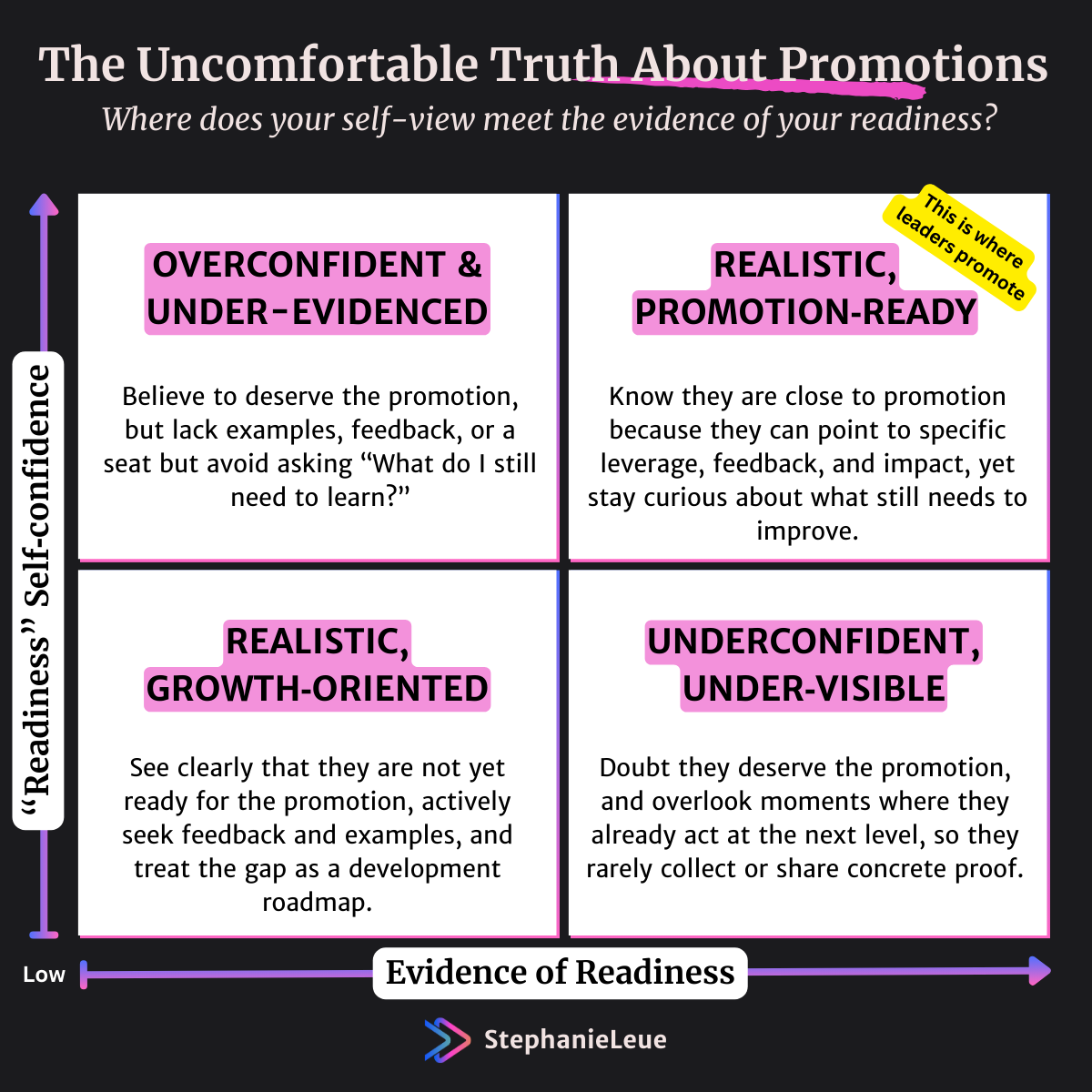
Reason 3: You’re confident – but not curious
Another pattern: people who are absolutely convinced they are ready.
They feel under‑recognized, under‑titled, under‑leveled.
Confidence is important.
But when it turns into overconfidence – “I deserve this” without evidence, feedback, or reflection – it becomes a blocker.
Leaders worry about promoting people who:
Don’t ask “What do I still need to learn?”
Don’t seek concrete feedback and examples.
Don’t show they can adjust based on that feedback.
The best promotions I’ve seen were almost boring:
The person had regular calibration conversations with their manager.
They knew the expectations for the next level in painful detail.
Together, they built a plan and tracked progress over months.
Overconfident people often skip this process. They expect the system to “notice” them. They treat promotion as something owed, not something they actively engineer.
If you’ve never asked, in writing, “What would you need to see from me over the next 6–12 months to confidently promote me?”, you’re probably operating more on hope than on a strategy.
What leaders really look for
From a leadership perspective, promotion readiness is less about your last project and more about your trajectory.
Leaders ask themselves:
Can this person operate at the next level without hand‑holding?
Do they already show the behaviors of that next level in how they think, decide, and collaborate?
Will their promotion increase the overall performance and health of the team – not just reward them? (recommended read: Promoting Your Top Performer Is Your Biggest Mistake. Here’s Why - by Rachel Wells)
Research shows that promoting top individual contributors into leadership roles just because they perform well often leads to worse outcomes: team performance drops, profitability declines, and the new manager struggles.
Why? Because leadership is a different job. It’s less about “doing” and more about enabling others to do their best work.
In product, that shift is especially visible:
From owning features to owning a problem space and portfolio
From managing tickets to managing context, strategy, and stakeholders.
From “my roadmap” to “our outcomes.”
If you want the promotion, start living this shift before anyone updates your title.
Questions to ask yourself (and your manager)
If you feel ready and still nothing moves, don’t stay in frustration. Use it as a mirror.
Reflect honestly:
Do I already show the skills and behaviors of the next level in my daily work – not just in my aspirations?
Can I name specific decisions, initiatives, or systems where I created leverage beyond my own output?
How do peers and stakeholders experience me: as someone who calms complexity and creates clarity, or as another source of noise?
Then make the invisible explicit:
Ask your manager for concrete promotion criteria, with examples.
Ask where they see gaps – skills, behaviors, impact, perception.
Ask what timeline would be realistic if you close those gaps.
You might not like the answers. But clarity is always better than quietly waiting another year.
And if the conversation reveals that there truly is no seat for you – not now, not soon – then the question is no longer “Why am I not getting promoted?” It becomes: “Where do I need to be so that my next step is possible?”
That’s the moment many careers shift from accidental to intentional.
Love this article Stephanie and appreciate the reference to my Forbes article. The readiness versus perception paradox is exactly what I see often in my work with aspiring leaders and is exactly why I created The Manager OS, to address and close that gap.