
Why Modern Product Operating Models Feel Impossible (to most of us)
You’ve invested in agile squads and top talent. Time to Value? . The invisible chains no one talks about.

I’ve been in Product for over 18 years, leading teams for over 10 years. I have seen PayPal transitioning from waterfall to glossy research labs, Contentful’s focus one outcome roadmaps and Doodle’s approach to refocus on building features customers love.
For most of us, our orgs look great on paper. You have agile teams, modern toolstacks, outcome-based roadmaps, UX research and a CPO role on the org chart. On slides, it looks like a modern product organisation. In practice, it often still feels like it takes half a year to change a single button.
This gap is not about talent or effort. It is about an invisible operating system underneath the surface that quietly pulls everything back to an industrial way of working.
Inside Product Org is a reader-supported publication. If you want more long-form content on real-world product leadership, you can subscribe for free or paid support.
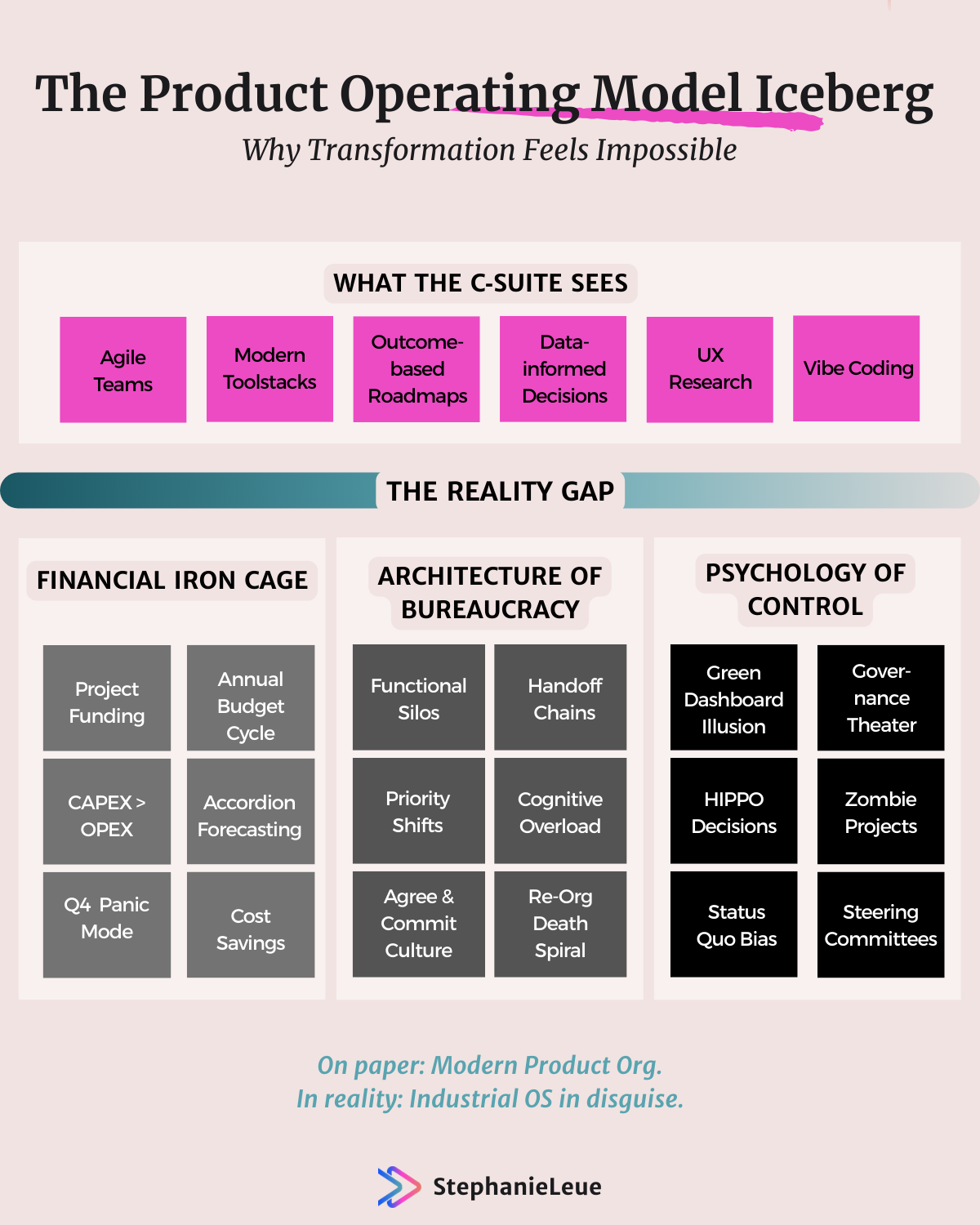
Above the Water: What the C‑suite sees
From the C‑suite, things often look promising. Agile teams are in place, the toolstack is modern, there are outcome-based roadmaps, dashboards full of data, dedicated UX work, even AI experiments in the codebase. Leaders see movement, new language, and a steady stream of initiatives. On the surface, it resembles a modern product organisation that has done its homework.
Below the water (what blocks movement)
1. The Financial Iron Cage
Below that surface, the way money flows tells a very different story. Work is still funded as projects with fixed scope, fixed timelines and fixed budgets, so teams are assembled temporarily and dissolved right after launch—or, just as often, they pitch initiatives with full energy, never receive proper funding, and keep working on ghost projects that quietly die two years later. By the time the first real learning from customers appears, the budget is usually gone, and any follow‑up has to wait for a new business case and the next annual cycle.
Annual budgeting keeps this pattern in place. In Q3 or Q4, organisations try to predict in detail what they will build more than a year ahead, locking in assumptions that will be outdated by the time development starts. Accounting then reinforces the problem: new features can be capitalised, refactoring and maintenance are treated as cost. As long as this financial operating system stays unchanged, teams are rewarded for output, even when everyone talks about outcomes.
2. The Architecture of Bureaucracy
The organisational setup adds a second layer of friction. Many companies introduce product teams, but keep their functional silos, handoff chains and legacy habits fully intact. Every change still depends on a long sequence of approvals and coordination steps, so no team can really own a problem from idea to impact.
Inside this environment, priorities shift with every escalation, and cognitive overload becomes normal. Teams are asked to “agree and commit” to plans that everyone knows will move, while leadership responds to symptoms with yet another re‑organisation that only deepens the death spiral. On slides this looks like cross‑functional collaboration; in daily work it feels like navigating bureaucracy instead of creating value.
3. The Psychology of Control
The third layer is psychological, and it is often the hardest to confront. Senior leaders naturally look for control in a complex environment: green dashboards, clear commitments, governance boards that promise risk management. These mechanisms create a sense of safety, but they also push organisations towards detailed upfront plans and away from experimentation.
Once a major initiative has an executive sponsor, sunk cost and reputation make it difficult to stop, even when evidence says it should. Highest‑paid opinions still dominate when data is ambiguous, and status‑quo bias pulls people back to familiar ways of working whenever pressure increases. The result is a system that speaks the language of empowered, outcome‑driven product teams, but behaves like a carefully controlled project machine. If that feels familiar, it is a sign that the visible practices have changed—but the operating system underneath has not.
Why this makes the operating model feel “impossible”
When these three blocks interact, they create exactly the experience many CEOs and product leaders describe.
Strategy looks modern. Roadmaps talk about outcomes and discovery.
Day‑to‑day reality is still dominated by projects, annual budgeting, handoffs, and control rituals.
Teams are expected to work like a digital product company while being funded and governed like an industrial one.
The gap between what the C‑suite sees and what teams live every day is not a sign of bad intent. It is the natural result of an operating system that was designed for another era.
Where to start
There is no simple checklist for replacing an industrial OS with a product OS. But the iceberg gives a practical starting point.
Look at how work is funded. Are you financing projects or stable product teams with clear outcomes?
Look at how work is structured. Can cross‑functional teams own a problem end‑to‑end, or does everything depend on handoffs?
Look at how decisions are made. Do you rely on dashboards and steering committees, or on small bets, learning and Cost of Delay?
Modern product practices only become real when these three layers change together. Until then, the organisation will continue to look agile on the surface and feel industrial underneath.
If this iceberg reflects your reality, you are not alone. And it is not a personal failure of your teams. It is a system problem—which is exactly why it can be redesigned.
Inside Product Org is a reader-supported publication. If you want more long-form content on real-world product leadership, you can subscribe for free or paid support.