
Leadership Friction Always Shows Up in Your Roadmap

By Stephanie Leue | Inside Product Org
Let me start with where it always ends up.
Users churning. Customers complaining about missing features. A roadmap that satisfies nobody. A team stretched so thin that everything takes twice as long as it should. A CEO who has stopped trusting the product org to lead. A business that is losing ground. Not because the product idea was wrong, but because the system around it quietly collapsed.
This is not a product problem. It is a leadership problem that found its way into the product.
In this series I have written about the four taxes that drain product leaders silently over time: the Trust Tax, the Alignment Tax, the Therapy Tax, and the Confidence Tax. Each one is real on its own. Each one is damaging on its own.
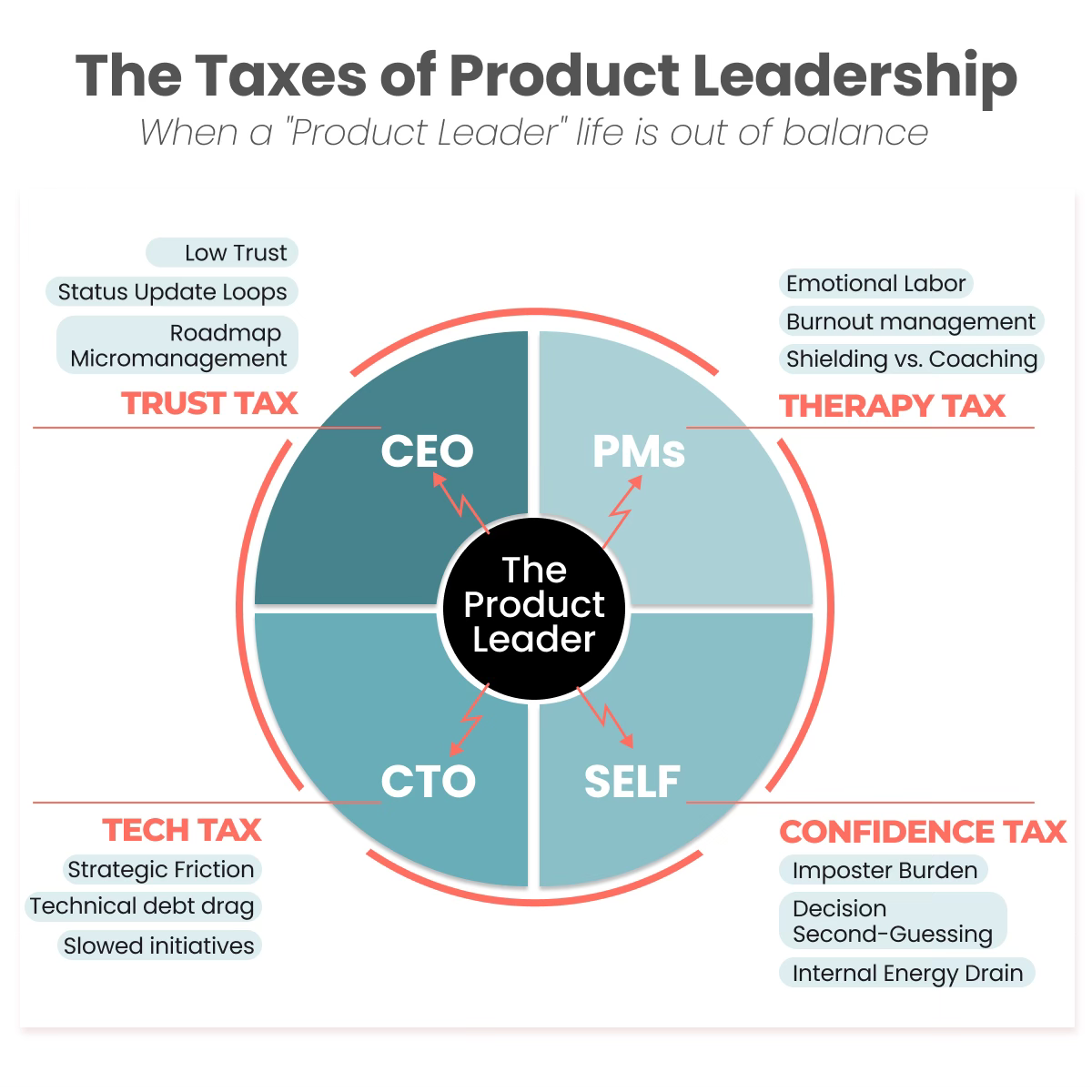
But what I have not yet said clearly enough is this:
Left unmanaged, they do not stay inside you. They flow outward. Into your team. Into your roadmap. Into your product. Into the experience your users have every single day. You cannot build a product users love if you cannot manage the system around you.
This article is about what happens when a leader finally does.
What the Taxes Look Like From the Outside
I am coaching product leaders now for over 5 years. What started as a side business will become my main job in June. More than once I worked with a product leader who was paying all four taxes at the same time. But one story from a VP product of a mid-sized B2B company struck me.
From the outside, the VP Product‘s situation looked like a product problem. From the inside, it was a leadership system that had completely broken down.
Sales controlled the roadmap. Not because anyone had decided that was the right model - it had just evolved that way over time, drip by drip, one feature request at a time. Sales sold things that didn’t exist yet. Product was not at the table when those conversations happened. The roadmap was not a strategy - it was an invoice.
He spent his days pushing back. Firefighting. Trying to create some order in an environment that was actively resistant to it. His CEO had started questioning his decisions - the Trust Tax, compounding quietly. His relationship with Sales had become adversarial - the Alignment Tax, draining every week. His PMs were overwhelmed and directionless, bringing their chaos to his 1:1s - the Therapy Tax, consuming the time he needed to think. And underneath all of it, his confidence in his own judgment was eroding - the Confidence Tax, the hardest one to name and the last one he admitted to.
He had no time to coach his PMs. No time to redesign the processes that were slowing everything down. No time to think about org structure or strategic direction. No time - and this is the one that costs the most - to talk to customers and understand the real problems the product needed to solve.
He was always at the edge. Delivering just enough to keep the engine running. But never enough to move it forward.
And the product showed it.
Customers churned because features they needed were missing - not because nobody cared, but because the roadmap was full of features individual sales reps had promised rather than problems that mattered at scale. Marketing couldn’t tell a coherent story because there wasn’t one. The board could feel the drift even if they couldn’t name it precisely. The business was suffering. And so was he.
The Moment He Stopped
At some point he recognized it.
Not everything at once. Just enough to know that continuing in the same direction was not an option.
He made one decision. Small, deliberate, specific.
He started joining sales calls.
Not to take over. Not to pitch. Not to manage the requests. Just to listen. To be in the room. To hear the conversations that were shaping his roadmap before they became feature orders.
What he found changed everything.
When he was present in those calls, he could ask different questions. Not “what do you want us to build?” but “what problem are you trying to solve for this customer?” Not “when do you need it by?” but “what would change for the customer if this problem was solved?”
Sales didn’t resist it. They responded to it. Because he wasn’t pushing back anymore - he was engaging. He was showing genuine interest in their world. He was walking into their conversations and helping them understand their own customers better.
Over time, the dynamic shifted.
Sales started trusting him. Not because he said yes to everything - but because they felt heard and because they could see he understood the problems they were dealing with. He had earned the right to push back, because the pushback now came with context and shared language instead of friction and defensiveness.
The Alignment Tax started dropping.
What Happened Next
With Sales moving from adversary to partner, something unlocked.
He was no longer just receiving feature orders. He was hearing problems. And as he accumulated more of those conversations - across customers, across segments, across the patterns that kept repeating - he started seeing what the product actually needed to solve.
He could connect the dots.
Individual feature requests started collapsing into shared problems. Three customers asking for three different things turned out to be the same underlying need, expressed differently. Instead of building three features for three customers, he could build one solution that served all of them - and several more they hadn’t spoken to yet.
The roadmap changed. Not overnight, and not without resistance. But the direction of it changed. It stopped being a list of promises and started becoming a set of bets - grounded in real customer problems, supported by the Sales team who now understood why, and legible to Marketing who could finally tell a coherent story about what the product was for.
The CEO noticed. Not because anyone gave a presentation about the change - but because the conversations in leadership meetings started feeling different. More grounded. More strategic. Less defensive. The Trust Tax started dropping too.
And with less time consumed by firefighting and misalignment, something else became possible.
He had time to think.
He used it to work on the org. To redesign processes that had been slowing the team down for years. To look at his PMs honestly and ask who needed what kind of support. His 1:1s shifted from absorbing chaos to genuine coaching. The Therapy Tax dropped.
And as all of this compounded - as trust grew, as alignment improved, as his team developed, as the product started moving in a direction he believed in - his confidence returned. Not the fragile kind that depends on everything going well. The grounded kind that comes from knowing you understand the system and can navigate it.
The Confidence Tax dropped last. It always does.
Why the Taxes Are a Product Problem, Not Just a Leadership Problem
I want to be direct about something that sometimes gets lost in leadership writing.
This is not just about you feeling better as a leader. This is not about wellbeing or work-life balance or personal development for its own sake.
This is about the product.
When the Trust Tax is high, you spend your energy justifying instead of leading. Your roadmap gets questioned in every meeting. Decisions get reversed. The team loses confidence in the direction. The product drifts.
When the Alignment Tax is high, mixed signals flow into every team below you. Sales promises things you haven’t built. Marketing tells a story the product doesn’t support. Engineering builds for stability while the business needs speed. The product gets pulled in four directions at once and moves in none of them.
When the Therapy Tax is high, your PMs are absorbing chaos instead of solving customer problems. Discovery gets squeezed out. The roadmap fills with reactive requests. The product stops being built for users and starts being built for whoever is loudest.
When the Confidence Tax is high, you stop making the calls that need to be made. You over-consult. You hesitate. You avoid the conversations that would unlock the team. The product stagnates because its leader has stopped leading.
Your users do not know your name. They do not know which taxes you are paying or what is consuming your energy behind the scenes. They just know whether the product solves their problem or not. Whether it is getting better or standing still. Whether it feels like someone who understands them built it — or whether it feels like it was built by a committee responding to whoever shouted loudest.
The leadership system is invisible to them.
Its effects are not.
What Mastering the System Actually Looks Like
The leader in this story did not transform his organization with a new framework or a restructuring program or a six-month strategy process.
He joined sales calls.
That is the point.
Mastering the system does not always start with a grand intervention. It starts with one deliberate action that addresses the most urgent tax - and creates the conditions for everything else to follow.
For him, it was Alignment. Once Sales stopped being an adversary and became a partner, the roadmap cleared, the CEO’s trust returned, the PMs got focus, and his own confidence rebuilt itself on something real.
For you, the starting point might be different. It might be a conversation with your CEO you have been avoiding. A hard discussion with your CTO behind closed doors. An honest look at what your 1:1s have become. Or a quieter, more internal reckoning with the self-doubt that has been running in the background.
But it starts somewhere specific. And it starts with you deciding that the taxes you are paying are not just a personal burden - they are a product problem that your users and your business cannot afford.
A Final Thought on What This Work Is For
I started this series by saying that the real tax of product leadership is not too much work.
It is the wrong work - the invisible weight that accumulates when the system around you is broken and you have not yet found a way to fix it.
The four taxes - Trust, Alignment, Therapy, Confidence - are the mechanisms through which that weight builds up. They are not character flaws. They are not signs of weakness. They are the predictable friction points of a complex role in a complex system, and every product leader pays some version of them at some point.
The ones who build great products are not the ones who never pay the taxes.
They are the ones who recognize them early, address them deliberately, and refuse to let them accumulate to the point where the product pays the price.
We are here for one thing above everything else: to build a product that users love and pay for, and to help the business grow because of it.
Everything else - the stakeholder management, the leadership development, the org design, the strategic alignment - is in service of that.
If you cannot manage the system, the system will manage you.
And your product will show it.
Ready to upgrade your Operating System?
💼 Follow me on LinkedIn for daily insights

This article is the final piece in my series on the Leadership Taxes that drain product leaders silently over time.
If you missed the earlier articles on the Trust Tax, the Alignment Tax, the Therapy Tax, and the Confidence Tax, you can find them here:
Part One: My Product Operating Model
Part Two: The Therapy Tax
Part Three: The Trust Tax
Part Four: The Alignment Tax
Part Five: The Confidence Tax
Part Six: This Article