
The Product Credibility Gap
Moving from "Feature Writer" to "Business Partner" to close the gap.

Imagine the boardroom: Sales flashes signed contracts—millions locked in. Marketing beams: “15% uplift from campaigns resulting in immediate revenue.” Growth celebrates quick wins, pointing to green arrows on the dashboard.
And then, there’s Product. We present visions. We show OKRs. We walk through roadmaps and celebrate releases. We tell future-oriented stories that feel distant next to their crisp charts. We complain about teams not knowing how their everyday work connects back to strategy and vision, while the other teams just…. deliver.
This dynamic creates a subtle trap, especially in organizations where product isn’t yet at the core. It is agonizingly hard to build trust when your value shows up as “theory” or “long-term bets,” while everyone else is showing “short-term wins.” Now add sprinkles of re-platforming, tech debt and harmonization to the equation and its guaranteed you lost your C-Level peers.
Many leaders pour their energy into transforming the org toward “modern product” practices, only to face (often unspoken) skepticism: “Where’s the proof?”
This isn’t about one function being better. It’s physics:
Revenue visibility builds trust fastest - especially in today’s reality.
(In my experience this has been a different reality a few years ago)
If you feel out of sync, it’s likely because your “Product DNA” doesn’t match the organization’s “Revenue Reality.”
The Diagnosis: The Product Culture Heatmap
I’ve created a Product Culture Heatmap to reveal where product models clash with revenue realities. Most burnout happens when you try to act like you’re in Zone 4 (Product Utopia), but your company actually lives in Zone 1 (Feature Factory).
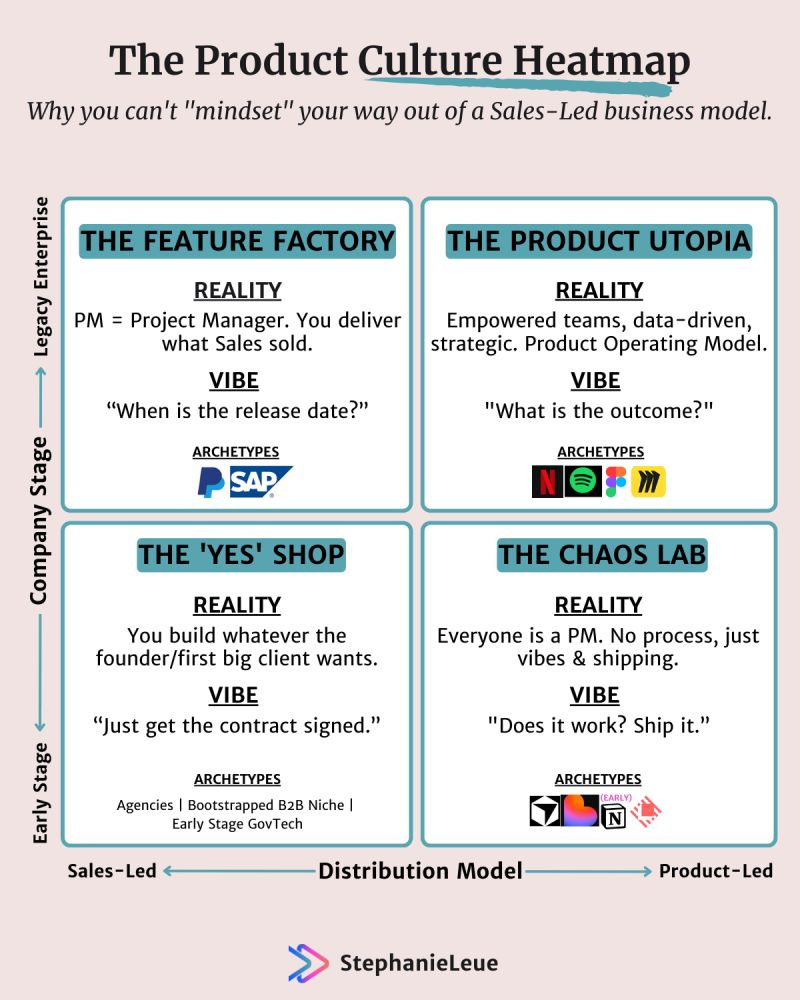
Zone 1: The Feature Factory (Sales-Led / Enterprise)
The Physics: Sales inks a $2M deal with five “must-have” features baked in - timeline included.
The Reality: Your roadmap equals a contract checklist. Deadlines rule. Scope creeps.
Your Role: Delivery Wrangler. Stakeholders chase dates, not outcomes.
The Trap: PMs burn out here questioning their discovery skills. But the enterprise demands project predictability, not product experimentation.
Zone 2: The ‘Yes’ Shop (Sales-Led / Startup)
The Physics: Cashflow is survival. Big client wants a custom integration? The door is open.
The Reality: One-offs stack into a Frankenstein product. Scalability is a problem for “later.” The team is often on fire and happily shifts gears.
Your Role: Agency Operative. Ship it to sign the deal.
The Trap: Founders cheer revenue while PMs grind. Early chaos feels heroic—until the exhaustion sets in.
Zone 3: The Chaos Lab (Product-Led / Startup)
The Physics: Revenue = Viral signups + stickiness. There is no sales buffer.
The Reality: Bad product = Dead company. Process is the enemy.
Your Role: Vibes Shipper. You hunt Product-Market Fit through raw velocity.
The Trap: Exhilarating at first, but pivots without end erode morale over time.
Zone 4: Product Utopia (Product-Led / Scale-Up)
The Physics: PLG maturity funds discovery. Retention drives growth.
The Reality: The company plans budget and mandates for empowered teams - across the org. Outcomes win.
Your Role: The “Textbook” PM. Continuous discovery and outcome roadmaps actually fit. (at least 70-80% of your time)
The Trap: This is the only place the “Product Operating Model” lands. Everywhere else? Crash landing.
Let’s be honest: Most organizations live in Zones 1 and 2. They operate on revenue-first physics. Pushing “Utopia” ideals in a “Feature Factory” feels like swimming upstream because the organization isn’t wired to value what you are selling yet.
P.S. I share these kinds of insights more regularly on LinkedIn too – connect there if you want the daily perspective on product leadership challenges - Always happy to connect with fellow Product Leaders there.
The Fix: Earn the Right to Transform
The source of the burnout is the Credibility Gap. You are exhausted from crafting “perfect” strategies while Sales racks up visible wins. The organization senses the disconnect.
So, how do you bridge it? You stop fighting physics and start using it.
1. Stop trying to force “Vision” before “Proof.” Don’t try to get the org to build the perfectly aligned vision before you’ve proven the impact you can make. If you are in a Feature Factory, deliver the feature and measure the result.
2. Speak “Commercial.” Do what you were hired for, but change the language. No story, no slide, and no update should exist without commercial context.
Instead of: “We are refactoring the backend.”
Try: “We are fixing the stability issues that caused X% of churn last quarter.”
3. Slice big ideas down. Pick an initiative, break it down, do the product magic (you know all the assumption mappings, hypothesis and experiments…), define measurable, revenue-linked targets. Deliver small chunks, measure them, and talk about the impact you created.
Practical tip: Partner with CS. They hold the keys to retention data. Use their insights to say, “Emails engage, but we fixed the retention root cause.”
4. Repeat until you have Trust. Repeat this loop. Deliver. Measure. Speak Revenue. Once it works? Now you can start talking about company alignment and transformation. You’ve finally built the trust to do it by speaking the language they expect.
The Payoff
When you make this shift, it feels organic. Confidence returns through visible impact. Teams rally around concrete, revenue-meaningful work.
Product becomes the quiet engine: Short-term enabler, long-term scaler. Burnout lifts because your transformation efforts are now flowing from proof, not just persuasion.
This is the work I do with CPOs and CEOs. If you want a sounding board for your product strategy, you can learn more here.