
The Options Trap: Why C-Level Teams Can't Commit
And how indecision burns out your best product teams

No leadership team lacks strategic options. If you walk into any boardroom today, the table is overflowing with them. The real shortage—the one that actually kills companies and burns out teams—is the courage to close those options and own the fallout.
Decision paralysis rarely stems from a lack of data or a “missing piece” of the puzzle. It stems from dodging responsibility.
In my 17 years in Product, I’ve seen that breakthroughs don’t happen through perpetual analysis; they happen through bold, defended bets. When executive waffling cascades down the org chart, it doesn’t just delay a launch; it burns out your best people and dilutes your brand until it stands for nothing.
The Allure of Keeping Options Open
Options are seductive. They allow executives to feel agile, open-minded, and intellectually heavy without demanding a single immediate sacrifice. It feels good to say, “We’re keeping our eyes on the market.”
In the boardroom, mantras like “let’s monitor and pivot” or “we need to remain fluid” craft a beautiful veneer of adaptability. It positions leaders as nimble visionaries navigating uncertain waters. But: usually, it’s just a cover for indecision.
This facade extracts a steep toll. Focus becomes scattered, and resources are splintered across ten “middling” efforts rather than one “winning” one. Your teams end up herding cats—chasing overlapping goals or, even worse, competing internally for the same scraps of budget and attention.
Before I sat at that table myself, I assumed this chaos masked some deep strategy visible only from the top. Experience proved otherwise. Humans at the table remain human—prone to faltering on tough calls, avoiding accountability, and dodging the social friction of saying “no.”
The Psychology of the “Safe” Bet
Prospect theory explains this pull quite well: we dread losses twice as much as we cherish gains. Often closing an option feels like a loss. It feels like self-harm.
We are also victims of status quo bias. We prize the ambiguity of “maybe” over the painful clarity of a “no.” If an executive makes a hard choice and it fails, they are blamed. If they make no choice and the company slowly stagnates, the blame is diffused across “market conditions.” It’s no wonder so many choose the latter. They defer the blame-laden act of deciding in favor of one more “discovery phase.”
Why Decisions Scare the C-Suite
A decision is a closed door. It crowns winners and losers, and it demands personal stakes—it is the dark mirror of optionality. (Even worse, many teams fall into the trap of re-opening 'closed' decisions the moment a minor obstacle appears. They live in an illusion of decisiveness, mistaking constant motion and debate for actual progress, while they are really just spinning in circles.)
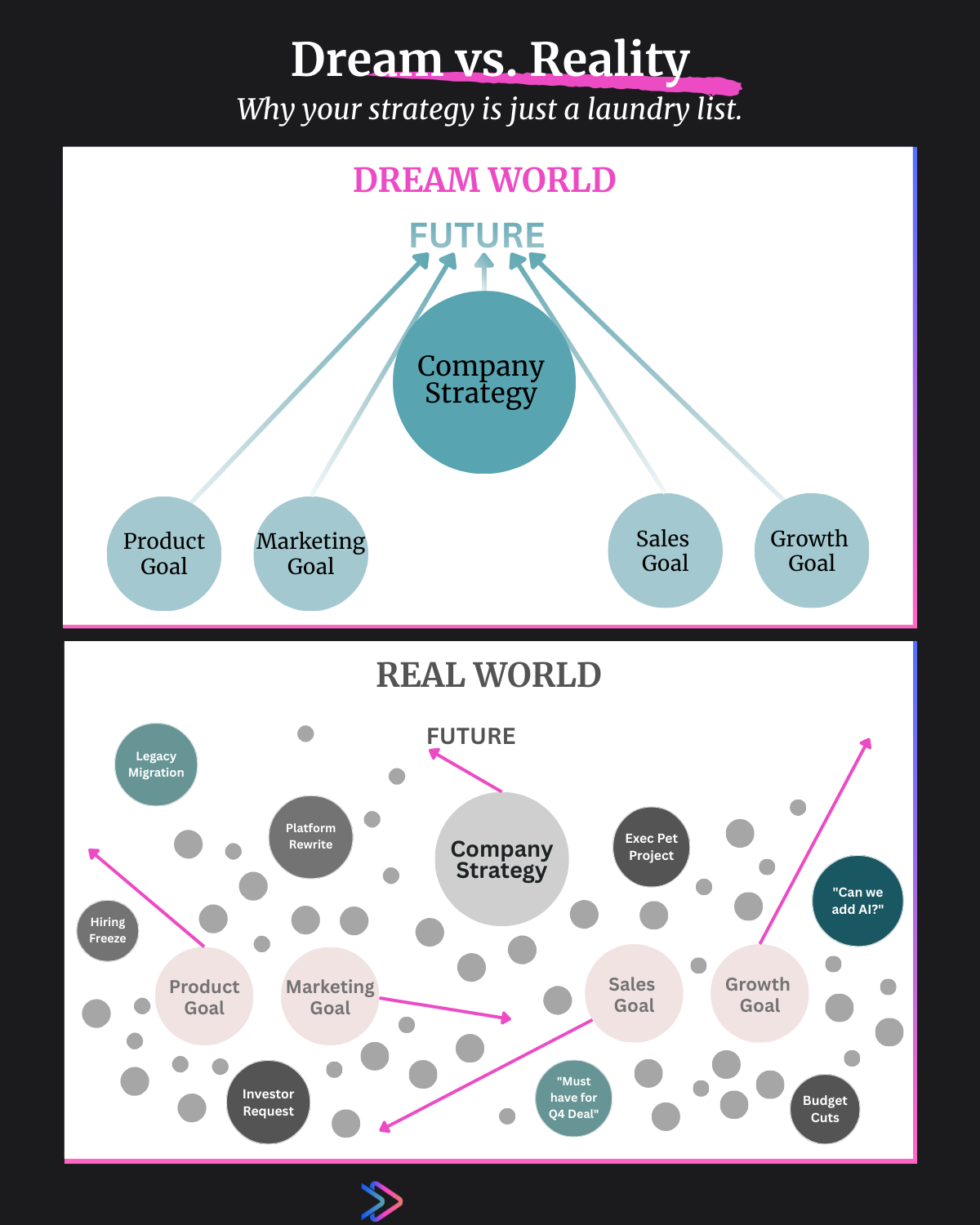
The moment you pursue one route, you shine a spotlight on everything you rejected. This ignites friction and “hindsight audits.” You’ve heard them: “Who was the champion for that failed project?” or “Why did we stop working on the AI initiative for this?” To avoid this heat, group dynamics often take over to diffuse ownership. No one wants to be the one holding the wheel when the car hits a bump, so the team collectively decides to let the car drift.
McKinsey flags this starkly: 72% of executives deem poor strategic choices “routine,” fueled by fuzzy roles and an overload of vocal stakeholders. Sales clamors for quick wins to hit quarterly targets; Engineering begs for technical debt fixes; Finance demands 24-month ROI proofs before a single line of code is written. This spawns “email marathons” and endless alignment meetings that masquerade as action. Aversion, not a lack of information, is what propels this. We ask for “one more model” to cloak our fear of being at fault.
The Execution Debt: A Hidden Tax
When executives flip-flop, they aren’t just changing a slide deck; they are shredding the fabric of their teams.
Morale doesn’t just dip—it craters. Trust evaporates. Velocity stalls as squads morph into “frantic responders” rather than builders. Think about your best engineers and designers. They want to solve hard problems. When they exhaust themselves on “urgent” sprints that are cancelled three weeks later, their initiative erodes. They start asking: “Why should I innovate when the target shifts every Monday?”
Research consistently ties leader indecision to rampant uncertainty and disengagement. Eventually, teams stop trying to win and start trying to survive. They withdraw. They wait for orders. They stop caring. This is the “Execution Debt” that takes years to pay off.
Shielding Teams Amid the Chaos
If you are a mid-level product leader or a VP, you are the shock absorber (or how I call it “sh**** umbrella). You cannot always stop the executive “weather,” but you can provide the umbrella.
Filter Ruthlessly: You must triage requests against a limited set of “sacred bets.” When a new “priority” comes from above, your answer should be: “This aligns (or doesn’t) with our core bets—here is why we are/aren’t moving it to the front.” You are the quarantine for the noise.
Set the Rhythms: Quarterly huddles should explicitly spell out what the team is not doing. Anchoring a team in what they can ignore is just as important as telling them what to build.
Lock Discovery: Secure at least 15% of your team’s time as “ring-fenced.” Frame this to the C-suite as a “risk-reduction” exercise. If we don’t do discovery now, we waste millions in development later.
Cultivate Empathy (The Hard Way): Fold executives into your team rituals early. Don’t just show them the “shipped” features; show them the “churn.” Let them see the ripple effects of a mid-quarter pivot. The hope: when they have “skin in the game,” they think twice before waffling.
The Product Strategy Iceberg
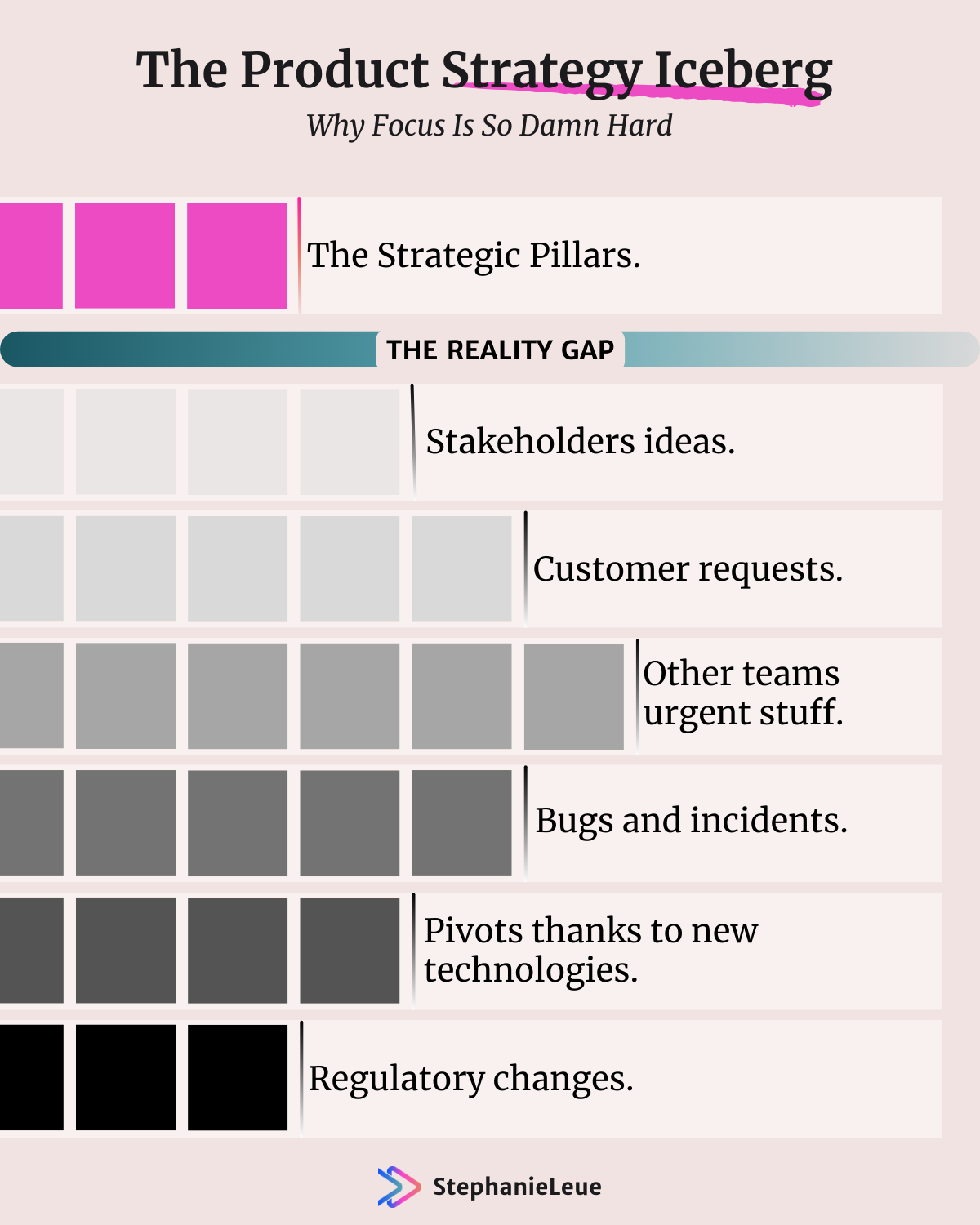
Indecision poisons a company quietly through “starved bets.” I call this the Product Strategy Iceberg.
Above the water, you see the “Strategy”—the big goals and the vision. But below the water is the massive bulk of daily deluges: bugs, small feature requests, “special” deals for Sales, and sudden pivots. If you keep saying “yes” to everything below the water, the Iceberg sinks. Your strategy is submerged by indiscriminate “yeses.” True mastery is keeping the strategy above water by hacking away at the ice below.
Actionable Shifts for Executive Teams
To escape “option limbo,” you need mechanical levers, not just “mindset shifts”:
90-Day Option Expiry: If an initiative hasn’t moved from “discovery” to “bet” in 90 days, it is killed. No “zombie” projects allowed to eat resources.
Frame the Trade-off: Stop saying “We aren’t doing X.” Start saying “By doing Y, we unlock the power to win Z.”
Broadcast the “Kill List”: Every quarter, publish what you are betting on and what you have killed. Tell the company: “Judge us on these three things. Ignore the rest.”
One-Pagers Over Slide Decks: Track the progress of bets on a single page tied to executive compensation. If the bet fails because of waffling, the bonus reflects it.
Commitment is Your Competitive Moat
In a world of wafflers, the company that can actually commit has a massive competitive advantage.
A handful of shielded, well-funded bets will always eclipse a sprawling portfolio of “options.” Companies like Spotify or ING understand this. They flatten their hierarchies and empower squads to move because the direction is clear. Waffling whispers frailty; sharp, defended bets broadcast strength.
After nearly two decades in Product and a few years having a seat at the table, the truth has crystallized for me: Options are just the raw material of leadership. Success only begins when you have the courage to choose. The next boardroom meeting is coming. Which paths are you going to seal?